Real estate organisations invest significant resources each year in condition assessments, building inspections and technical reports. The purpose is simple: to create an overview of building condition and ensure that maintenance activities are planned in time.
Even so, many organisations find that maintenance decisions are still made under uncertainty. The reports exist, but they do not always translate into an overall strategy for the portfolio.
This is not due to a lack of professional expertise. Rather, the leap from technical condition assessments to strategic prioritisation across many buildings is far greater than is often assumed.
This page explains how organisations can move from condition assessments to maintenance planning and strategic decisions at the portfolio level.
In recent years, the topic has received growing attention across the real estate industry. In Denmark, several organisations, including the Danish Association of Construction Clients (Bygherreforeningen), have published guidance on how condition assessments can form the foundation for planned maintenance at the portfolio level. What these initiatives share is the recognition that the assessment itself is only the starting point. The real challenge lies in translating building data into prioritised decisions over time.
What is strategic maintenance planning?
Strategic maintenance planning is the process through which condition data from buildings is translated into prioritised decisions across a property portfolio.
Instead of assessing each building in isolation, the portfolio is analysed as a whole. Maintenance tasks are evaluated in relation to budgets, risks, regulatory requirements and the long-term goals for the properties.
The aim is to create a decision framework that allows organisations to prioritise maintenance systematically, plan investments over longer time horizons and reduce the need for urgent repairs.
Strategic maintenance planning typically relies on three elements:
• structured condition assessments of buildings
• long-term maintenance plans
• scenario analysis for prioritisation and budget allocation
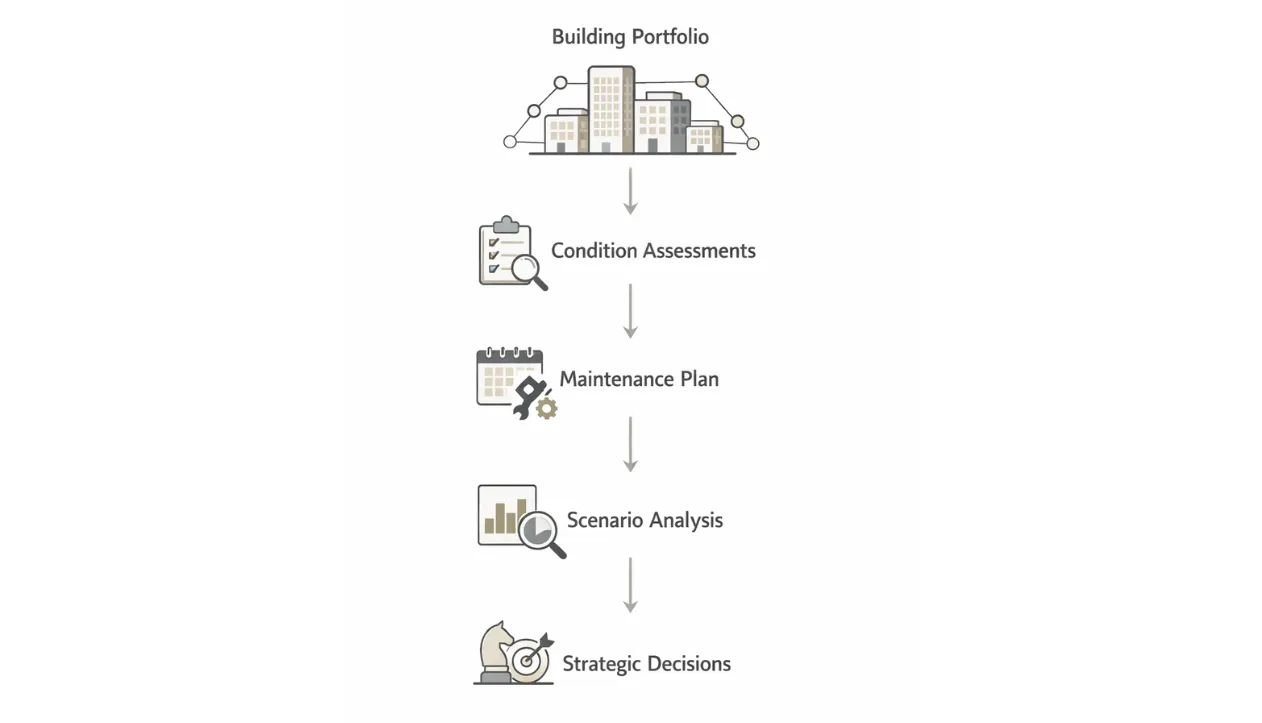
The process from condition assessment to strategic decisions
Strategic maintenance planning can be understood as a process in which condition data is gradually translated into prioritised decisions.
This process can be illustrated in four main steps:
• Condition assessments create a structured overview of the technical condition of buildings.
• Maintenance plans translate condition data into concrete tasks, schedules and investment needs.
• Scenario analysis enables different priorities to be compared across property portfolios.
• Strategic decisions are made based on data, budgets and the organisation’s long-term goals.
This structure helps organisations move from stand-alone assessments to a more systematic and long-term approach to managing maintenance across portfolios.
Maintenance decisions are portfolio decisions
Maintenance is often discussed at the level of individual buildings. A report may indicate that a roof should be replaced within a few years or that a façade requires repair.
In practice, decisions are rarely made that way. A portfolio owner typically needs to prioritise between many competing needs. A roof replacement on one property may compete with façade work on several others.
At the same time, budget constraints, energy requirements and organisational priorities influence which projects can be carried out. The technically optimal decision for a single building is therefore not necessarily the strategically optimal decision for the portfolio.
Maintenance planning is therefore not just about identifying problems. It is about prioritising between them.
What a condition assessment actually provides
Condition assessments play a key role in this process. They create a structured picture of the technical condition of buildings and identify components that are approaching the end of their useful life.
Typically, key building elements such as roofs, façades, windows, technical installations and drainage systems are assessed. The result is a technical overview of the portfolio at a given point in time.
This overview is a prerequisite for planning. Without a structured data foundation, maintenance decisions tend to become reactive, with organisations responding only once damage occurs.
But the condition assessment is only the first step. It describes the situation. It does not determine what should be done.
Where the process often stops
In many organisations, the process effectively stops after the condition assessment. Reports are produced and maintenance needs are identified.
The next step often proves more difficult. The organisation is now faced with questions that cannot be answered by a single report.
Which projects should be prioritised first? Which can be postponed without significantly increasing risk? How do maintenance needs align with available budgets? And how will the condition of the portfolio evolve over time?
These questions require a portfolio-level overview in which multiple buildings and different types of maintenance tasks are evaluated together.
Maintenance backlog and long-term consequences
When maintenance tasks are postponed, a backlog gradually develops across the portfolio. In the beginning, the consequences may be limited. Minor repairs are delayed and buildings continue to function.
Over time, however, the situation changes. Deferred tasks begin to affect each other, and small issues can develop into larger renovation projects. At the same time, it becomes increasingly difficult to maintain a clear overview of how large the maintenance backlog actually is.
This is precisely why many organisations now work with more systematic maintenance planning. The goal is not only to identify upcoming tasks, but also to understand how decisions made today will affect the condition of the portfolio many years into the future.
The maintenance plan as a strategic tool
The next step is to translate condition data into a maintenance plan.
A maintenance plan compiles identified needs into a structured overview of which tasks should be carried out, when they should be completed and what costs are associated with them.
When developed at the portfolio level, the plan becomes a strategic tool. It allows technical needs to be balanced with budgets, organisational priorities and regulatory requirements.
At the same time, the plan creates a shared basis for decision-making. Technical teams, finance departments and management can work from the same framework rather than relying on separate reports and spreadsheets.
Prioritisation and scenarios
Even with a maintenance plan, there is rarely a single obvious solution. Budgets are limited and many tasks compete for the same resources.
For this reason, many organisations work with scenarios. A scenario may show how the condition of the portfolio evolves under current budgets, what happens if investments are brought forward, or what consequences postponements may have.
Scenarios make the implications of different decisions visible. Management may see that lower investment levels produce short-term savings but also increase the risk of future damage or major renovations.
In this way, maintenance becomes a matter of prioritisation rather than reactive firefighting.
Implementation in the organisation
Even the best maintenance plan only works if it is integrated into the organisation’s daily operations.
This requires clear roles between operations, finance and management. It requires regular updates of condition data. And it requires alignment between maintenance planning and budget processes.
Maintenance planning is not a one-time analysis. It is an ongoing process in which both the condition of the portfolio and the plans themselves are updated over time.
When this process functions well, maintenance gradually shifts from reactive repairs to planned and preventive efforts.
Where digital tools make a difference
As portfolios grow larger, the complexity quickly becomes difficult to manage manually. A portfolio with many buildings may contain thousands of components with different lifetimes, risk profiles and cost structures. At the same time, regulatory requirements, energy targets and budget frameworks continually reshape the decision landscape.
Digital tools can help organizations structure this information and make the connection between data and decisions clearer. In recent years, AI-based maintenance planning systems have also begun to support this process by analyzing condition data and scenarios across portfolios.
Modern systems can, among other things, support structuring building data, constructing long-term maintenance plans, scenario analysis across portfolios, and documenting decisions over time. You can read more about how AI works in maintenance planning in our review of the technology.
At the same time, it is important to understand that not all AI approaches are equally suitable for this type of decision problem. Many general-purpose AI models lack the necessary domain understanding to handle portfolio-level maintenance decisions. We discuss this in more detail in the article why generic AI falls short in property maintenance.
The purpose of digital tools is not to replace professional assessment. The aim is to provide decision-makers with a more consistent basis for their priorities.
From Data to Decisions
Condition assessments create insight into the condition of buildings. Maintenance plans translate this insight into concrete tasks. Strategic maintenance planning links the tasks to long-term decisions for the portfolio.
When organizations work systematically with this process, maintenance becomes more predictable. Risks are detected earlier, investments can be better planned, and decisions can be explained and documented.
The key challenge, therefore, is not identifying maintenance needs. The key challenge is to prioritise them.
It is precisely in this priority that data-driven methods and modern decision-making tools can make the biggest difference.
Final Perspective
As property portfolios become larger and more complex, the need for structured maintenance planning is becoming increasingly apparent. Condition assessments provide an important starting point, but real value only emerges when data is translated into priority decisions across portfolios.
At proprty.ai, we work to support this process by combining structured building data, maintenance models and scenario analysis. The aim is not to replace professional assessment, but to provide property owners and operating organisations with a better basis to plan maintenance systematically across their portfolios over time.


Subscribe to our newsletter
Get insights into new features, customer cases, and news from proprty.ai, delivered straight to your inbox.