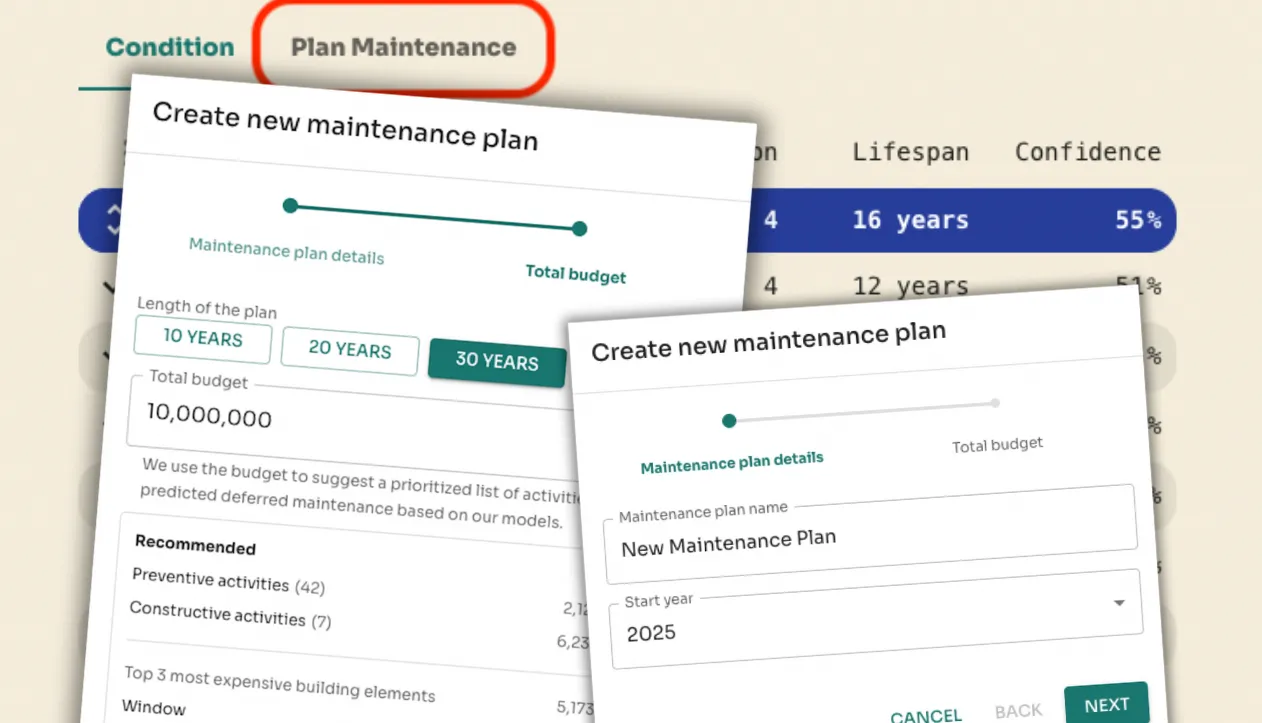
A new feature has been launched in proprty.ai: Cost Optimization!
What is it and how does it work? That is the focus here.
Why do we need cost optimization?
Condition assessment and maintenance planning have been a central part of proprty.ai for some time. Residual life and maintenance budget suggestions are automatically generated by models trained on large amounts of data. The models are the foundation for the maintenance plans that are made in the app.
But what are the consequences of not carrying out activities on certain building parts? How do we prioritise which parts of the building need to be maintained and which activities can be postponed if the budget does not cover everything?
Cost optimization addresses those issues.
The engine room
The algorithm takes into account a number of parameters that describe each individual building part, including, among others:
- Expenditure for preventive maintenance
- Cost of maintenance (major repairs or replacements)
- Residual life
- Ignorance (how much faster a building part deteriorates without preventive maintenance)
- Damageability (how much faster other building parts deteriorate when that building part is nearing the end of its useful life)
- Safety and legal requirements
All activities in the plan are prioritized first according to safety and legal requirements, and then according to damage capacity.
Here are a few examples of situations that may arise in maintenance planning:
- The roof covering on a building is old, giving rise to several leaks. In the long run, this will damage the roof structure, the ceiling and other building parts. The initial maintenance of the roof will therefore be a high priority.
- The balconies are in poor condition and at risk of collapse. Building maintenance is prioritised for safety reasons, even if their condition does not directly damage other building components.
- The kitchen is in such poor condition that it is useless. Renovating the kitchen will be a low priority, as a broken kitchen neither creates safety risks nor causes damage to other building parts.
- The windows in a building deteriorate much faster if preventive maintenance is not done. Preventive maintenance of windows is therefore given high priority, as replacement is much more expensive.
- The exterior door of a building is very expensive to do preventive maintenance on, almost so expensive that it costs the same as replacing the door. In that case, maintenance is skipped and the door is replaced earlier instead.
If the planned maintenance budget is lower than that proposed from the cost model, activities according to this priority are removed. The model also estimates technical debt: the extra costs incurred when a lack of funds leads to deferred maintenance.
Walkthrough
Cost optimization occurs every time a new maintenance plan is created. The functionality has replaced the previous way of making maintenance plans. Simply tap “Schedule Maintenance” on a property's page to get started.
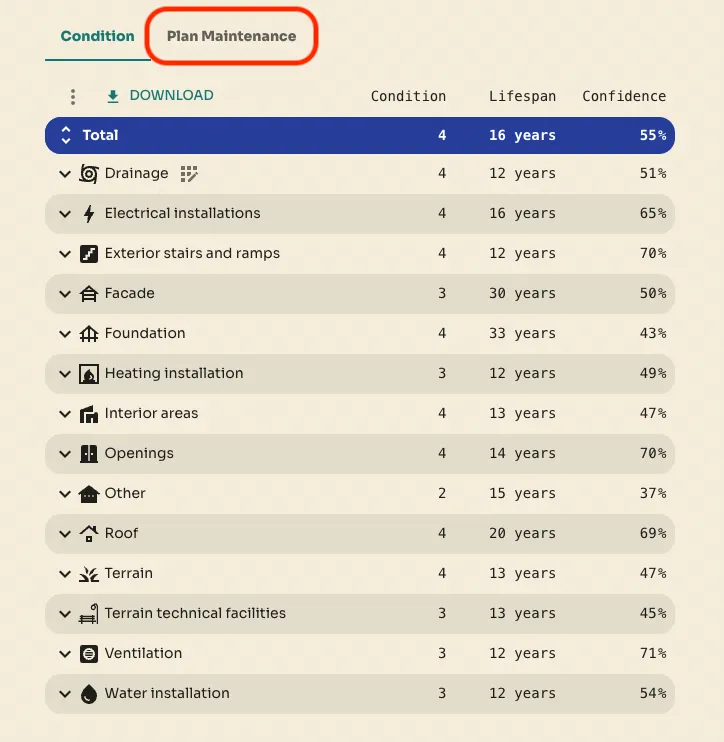
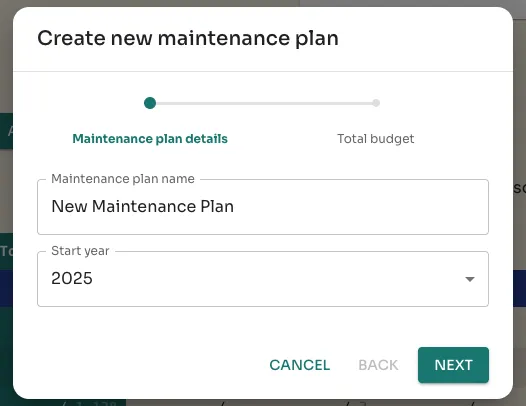
The box for creating plans now includes a new step called “Total budget.”
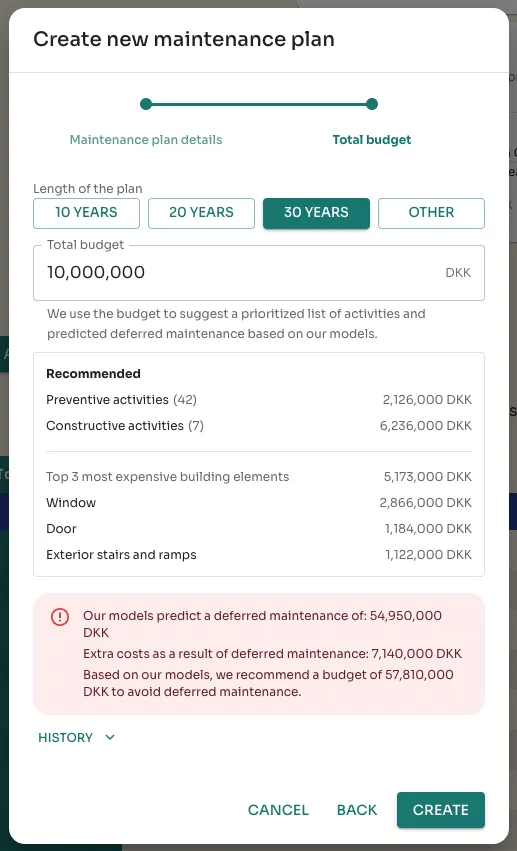
When you click “next”, a new page with several key ratios will appear in the optimization window:
The total budget from proprty.ai's cost model is suggested by default. The figure can then be adjusted according to the budget, which is available at the property. The optimization occurs when a budget, which is lower than the proposed one, is entered.
The activity summary shows the total number of preventive and corrective activities, as well as the most expensive tasks in the plan. A red box will appear if the budget is too low.
Here we see how much technical debt accumulates as a result of lack of maintenance. Estimates for additional costs caused by the poor condition of key building parts are also shown, as well as our recommended budget.
When the plan is created with the desired budget, a maintenance plan is generated that contains only those proposals that are within the budget framework. Planning of activities is then carried out in the same way as before.
Concluding remarks
The first steps towards proposing smarter property maintenance plans have been taken. With cost optimization, we no longer just make a plan. We also estimate the technical debt incurred when one does not follow it, while prioritizing the available funds for the most important building parts.
We hope the new functionality will help create better and more intelligent maintenance schedules and make it easier to organize budgets efficiently, with technical debt as an integral part of the process.


Subscribe to our newsletter
Get insights into new features, customer cases, and news from proprty.ai, delivered straight to your inbox.