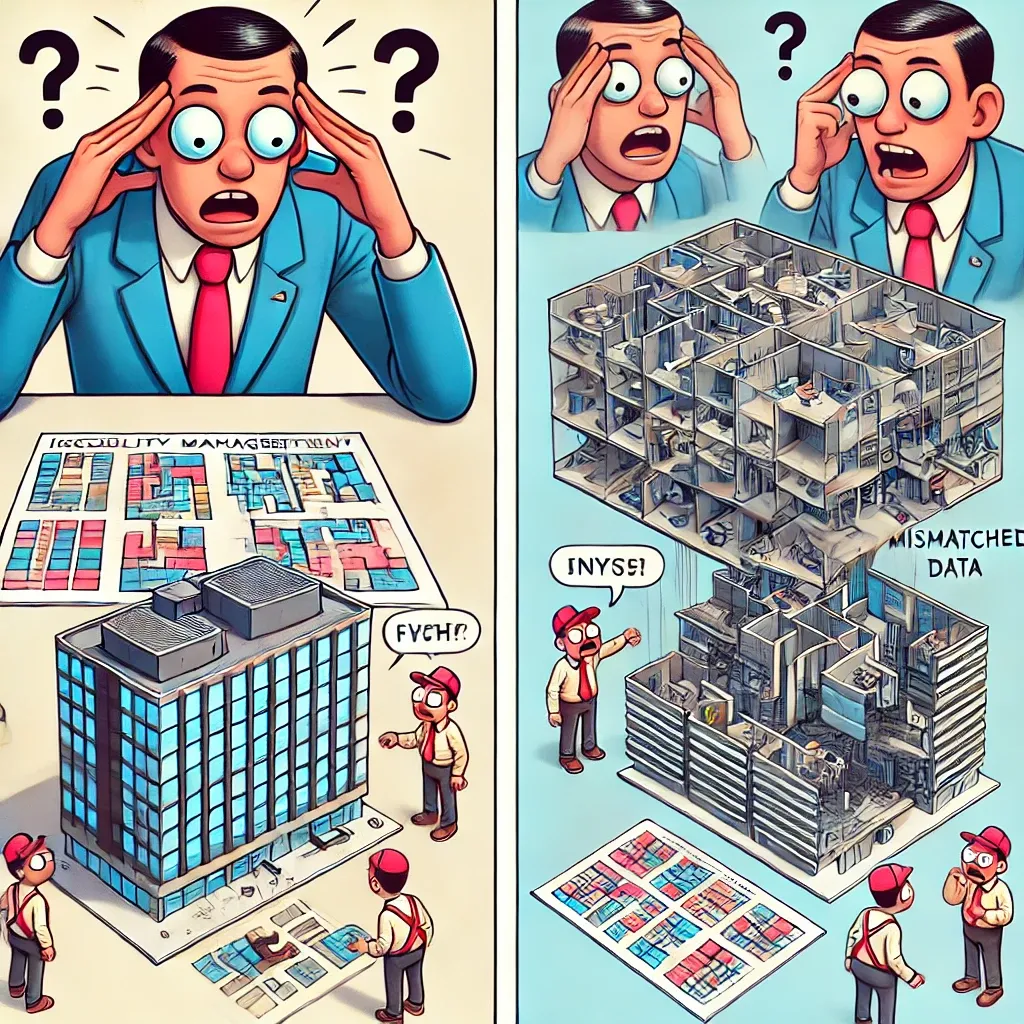
When deploying an FM system, it is crucial to distinguish between what is critical and what is important. Unfortunately, it often happens that decisions are made that aim to cover needs that should be categorized as important rather than critical. This can lead to twisting the functionality of the system and figuratively speaking, taking a shoe on your hand and calling it a glove. The result is a data model that deviates from physical reality, creating a number of challenges.
One of the biggest challenges of deviating from physical reality is that a proprietary logic is constructed that only makes sense with the individual real estate business.
This makes for inefficient workflows and creates a complexity for new employees and others external to work in the system simply because the logic is unknown.
Furthermore, it imposes costs and unnecessary tasks in system maintenance, which are often underestimated at the moment of decision. A rule of thumb is that you need to multiply the implementation cost by a factor of 10 to get the real cost.
Next, it has major implications for the ability to integrate and take advantage of the many cool proptech solutions that are emerging. The cost and implementation time is significantly increased to integrate these, since it requires a translation of the proprietary logic into the data and information models of other systems. Maintaining these integrations is also going to be a major challenge.
BBR may be the key!
To avoid such problems, it is important to use a common information model. The Buildings and Housing Register (BBR) offers a solution with its unique ID, called a BFE number, which creates unique hierarchies and relationships that accurately reflect the real world.
At proprty.ai, we see great value in using a common information model. This not only creates a more logical and coherent data structure, but also makes the maintenance and use of the system much more user-friendly for the ordinary user.
We're hoping for that.
The challenges of FM systems and their data models are many and complex, but they can be overcome by using common information models such as BBR. By ensuring that data accurately reflects the physical world, you can create a more efficient and user-friendly solution that benefits both companies and public institutions. Investing in a logical and coherent data model is key to avoiding the manual processes and illogical data that many FM systems are unfortunately characterized by today.


Subscribe to our newsletter
Get insights into new features, customer cases, and news from proprty.ai, delivered straight to your inbox.