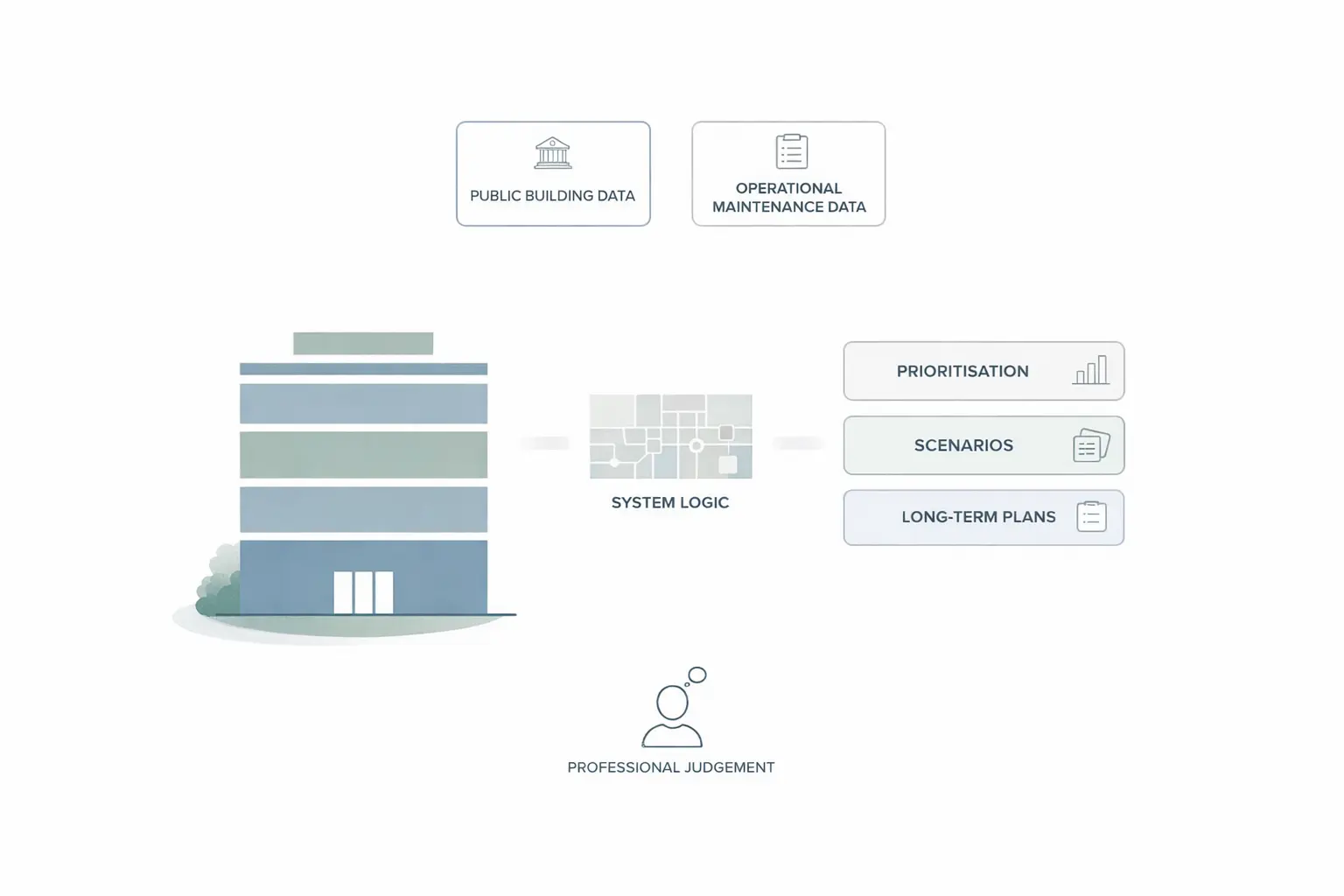
AI in property maintenance is not only about predicting failures. It is about structuring decisions across a portfolio: what to do first, what can wait, and how today’s actions shape future options.
This page explains how that works in practice, from how buildings are modelled and data is combined, to how prioritisation and scenario analysis support professional judgement over time.
Buildings as systems of components
Most property data treats a building as a single asset. AI that supports maintenance planning cannot. A building is a collection of components, each with its own material, age, usage pattern and expected lifetime. Roofs, facades, windows, heating systems, drainage and electrical installations all age differently, fail differently and cost differently to replace.
In a maintenance-oriented AI model, each component is represented separately. A flat roof on a 1970s concrete building behaves differently from a pitched tile roof on a 1920s brick building, even if both are nominally “roofs.” The model captures this by linking component type, material, construction year and building context into a structured profile.
This matters because maintenance decisions are rarely about one component in isolation. Replacing a roof may require scaffolding that also makes facade work accessible. These dependencies are only visible when the building is modelled as a system rather than a line in a spreadsheet.
The data that feeds the models
AI models for property maintenance rely on two types of structured data working together.
Public register data provides the structural foundation. Across Europe, countries maintain building registers and energy performance databases that capture construction year, building type, size, heating source and renovation history. What differs significantly between markets is the quality, coverage and consistency of this data, and whether it can function as a shared source of truth across portfolios. In some markets, such as Denmark, these registers are comprehensive, standardised and consistently updated, covering the full building stock and providing a strong baseline for modelling. This level of coverage and consistency is unusual internationally and makes it possible to build and validate maintenance models in ways that are not feasible where data is fragmented or incomplete.
In all cases, public data gives models a starting point, even for buildings that have never been formally inspected. Where register data is incomplete, input can be supplemented through other sources, such as imagery, without changing the underlying model.
Operational data from property owners adds the layer that public data cannot capture. Inspection records, maintenance logs, known defects, planned investments and budget allocations reflect what is actually happening on the ground. A building that looks identical to its neighbour in the register may have a recently replaced roof or a known moisture problem that changes its entire maintenance profile.
Neither source is sufficient alone. Public data provides coverage and consistency. Operational data provides accuracy and context. Combined, they create a structured, portfolio-wide foundation that models can reason over.
The quality of outputs is always tied to the quality of inputs. Effective systems are therefore designed to work with what is available today, to make assumptions explicit, and to improve as more data becomes available over time.
This does not mean retraining models for each portfolio or market. It means applying the same underlying decision logic to different buildings, using the best available input data in each context.
How remaining lifetimes and costs are estimated
At the core of maintenance AI is the estimation of remaining useful life for each component. This is not a single number. It is a probability distribution that reflects uncertainty in the data, variation across buildings and the influence of external factors like climate, usage intensity and maintenance history.
A model might estimate that a flat roof has a meaningful probability of requiring replacement within a shorter horizon, and a higher probability over a longer horizon. That range is more useful than a point estimate because it reflects reality: components do not fail on schedule. The distribution allows decision-makers to understand exposure and to plan around uncertainty rather than pretending it does not exist.
Cost estimation works similarly. Replacement costs are modelled as ranges that account for building-specific factors such as access, scale, material choices and regulatory requirements. These ranges feed directly into budgeting and scenario analysis, where the question is not “what will this cost?” but “what is the range of outcomes, and how does that interact with other planned investments?”
How prioritisation works across a portfolio
Predicting when a component will need attention is only the first step. The harder problem, and the one where AI adds the most value, is prioritisation across a portfolio.
A portfolio of several hundred buildings might have thousands of components, each with its own condition trajectory, cost profile and risk exposure. Prioritisation means comparing all of these against shared constraints: available budget, regulatory deadlines, organisational capacity and strategic objectives.
This is where the model moves beyond component-level prediction. It evaluates trade-offs: what is the cost of deferring a roof replacement by two years? How does that deferral change risk exposure? Does it free up budget for facade work that reduces energy consumption and improves regulatory compliance? What happens to the ten-year cost profile if energy standards tighten next year?
The output is not a ranked list. It is a structured view of how different choices interact and what each path implies for cost, condition and compliance over time.
Scenario analysis: making trade-offs visible
Scenario analysis is the mechanism that translates AI outputs into something decision-makers can work with. Instead of presenting a single recommended plan, the system allows users to explore alternatives and understand consequences.
In practice, scenario analysis often compares paths such as:
- A baseline plan that follows current budget allocations
- An accelerated plan that front-loads energy-related investments
- A deferred plan that reduces spending in year one but accepts higher costs and risks later
- A constrained plan that reflects a budget cut and shows what must be deprioritised
For each scenario, the system shows how cost, condition, risk and compliance develop across the portfolio over a defined planning horizon. This makes trade-offs concrete. A board can see that deferring investment saves money in the short term but increases total cost over a longer horizon by a quantifiable margin. A technical manager can see which buildings are most affected by a budget change and where risk concentrations emerge.
The value here is not that AI produces the right answer. It is that the system makes the structure of the decision visible, so that professionals can apply their judgement to the right question.
What AI cannot do
AI in property maintenance can estimate lifetimes, model costs, quantify risk and structure trade-offs. It cannot determine what matters most.
How much risk is acceptable? Should energy performance take priority over structural maintenance this year? Is it worth accelerating investment to avoid political pressure, even if the technical case is weaker? These are questions of intent, values and organisational context. They belong to the professionals and decision-makers responsible for the portfolio.
Clear separation between what AI estimates and what humans decide is not a design preference. It is a requirement for trust, accountability and practical adoption. When the boundary is blurred, outputs become harder to challenge, harder to explain and harder to defend in governance processes.
How this is applied at proprty.ai
At proprty.ai, these principles are applied to support maintenance planning for professional property owners across Europe. Structured public data from building registers and energy databases is combined with operational data from owners, managers and FM systems to build component-level models across entire portfolios. Professional users remain responsible for final decisions, approvals and execution.
The system supports the full decision cycle: condition assessment, prioritisation, scenario analysis and long-term budget allocation. Regulatory requirements, budget cycles and documentation needs are built into the decision logic rather than treated as separate concerns.
As the approach is applied across markets such as Germany, Norway and the Netherlands, it adapts to local data sources and regulatory environments while preserving the same underlying structure: component-level modelling, structured data integration and decision support designed around real operational constraints.
If you are responsible for maintenance planning or portfolio-level investment decisions and want to understand how this approach applies to your context, we are happy to walk through it using your data and constraints.


Subscribe to our newsletter
Get insights into new features, customer cases, and news from proprty.ai, delivered straight to your inbox.