After some months of work processing pre-existing data and obtaining more data from known and emerging sources, we have now put the second version of our model to predict maintenance costs in production. The model is used to estimate maintenance costs for building parts when creating a maintenance plan in the app.
Why a new model?
The main difference between the new and the previous version of the model is that we now have much more data, which has made it possible to make a model that is more robust and better at generalizing to new properties, and that can provide predictions at a more detailed level. The previous version of the model was able to predict maintenance costs for an entire property/department, i.e. a collection of buildings, and then a fixed average distribution of costs across building parts was used to predict maintenance costs for the individual building parts under the property. The new version of the model predicts maintenance costs all the way down at the building-part level, and on the individual building under a property rather than the entire property overall.
The fact that this can now be done is due to the following:
- The new version of the model is trained on 336,487 more unique building parts under 801 more properties than the previous version.
- The National Building Fund collects maintenance costs at the building subdivision level, which are predicted by external advisers to the general housing companies. The previous version of the model was trained solely on these maintenance costs. In the new version, we use the maintenance costs from our customers' own internal maintenance plans as a starting point, and supplement with costs from the external audits for building parts with no costs from our customers. In the future, we will also use maintenance costs, which are entered into the app, so that we get training data from a wider sample of our customers.
The amount of information that is used as input to the model to make predictions has also grown significantly. The previous version of the model used exclusively the following information about a property from BBR: Number of sq. building, total built-up area, most prevalent facade materials, and earliest renovation year of a building under the property. The new version of the model uses the following information from the following sources:
- Our customers' maintenance plans: Building parts quantities, materials, years of installation and remaining service life.
- National Construction Fund calculation sheet: Building parts quantities, materials, year of installation and remaining service life.
- levetidstabeller.dk (BUILD - Aalborg University): Average lifetime of building parts based on material.
- Statistics Denmark: Area and population density in municipalities, postal districts and postal codes.
- The Danish Energy Agency: The energy label of buildings.
- BBR: Number of buildings sq. (total and divided by residential and commercial and built-up area), use, year of construction and renovation, roofing and facade materials and type of water supply, drainage and heating installation.
Property-level precision
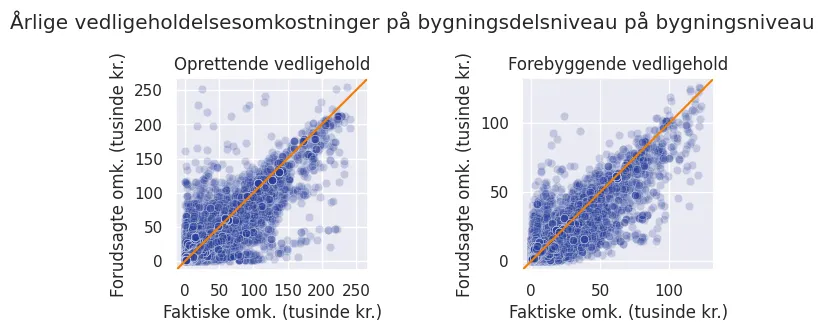
In the data from our customers' own budgets and the reviews made by external suppliers, it can be seen that the estimated maintenance costs for the individual parts of a building can vary greatly, since it is a subjective assessment that depends on who makes it. It is also reflected in the graph below, which compares the predicted and actual maintenance costs at the building-part level from the new version of the model. For a model that always guesses 100% correctly, all the points will be on the diagonal line, and in the graph you can see that, especially for building parts with maintenance costs at the low end, there can be quite large fluctuations in how close the model's predictions are to actual costs.
If, on the other hand, you sum up the costs of all building parts under all buildings under a property/department to get the total cost of the entire property/department, then there is greater consensus across sources, which is also reflected in the graph below, which shows the same ratio as in the graph above, just at the property/department level. Here you can see that the predicted maintenance costs at the property/department level are very close to the actual costs.
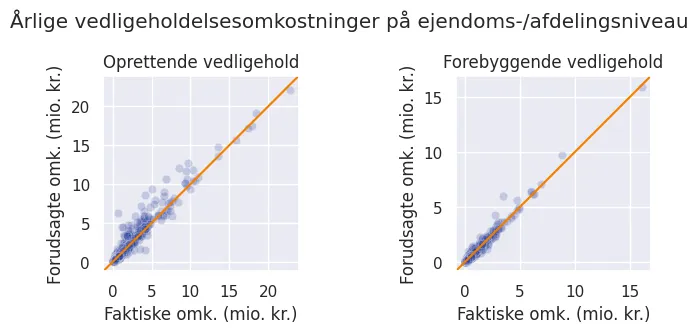
R2 is a statistics measurement, which is used to assess how good a model is at making predictions. The number is between 0 and 1, and a model that always guesses correctly will have an R2 of 1. The new version of the model has an R2 of 0.8 when tested on new properties at building subdivision level for both corrective and preventive maintenance. That is, 80% of the variation in maintenance costs can be explained by the variation in the input parameters (BBR information, quantity, material, etc.). At departmental level, R2 comes to 0.88 for corrective maintenance and 0.96 for preventive.
We are pleased to offer improved maintenance estimates and are excited to get feedback from our customers. And then we have a lot of ideas on how the estimates can be improved even better, including information on protected properties and the distance to the nearest coastline.


Subscribe to our newsletter
Get insights into new features, customer cases, and news from proprty.ai, delivered straight to your inbox.