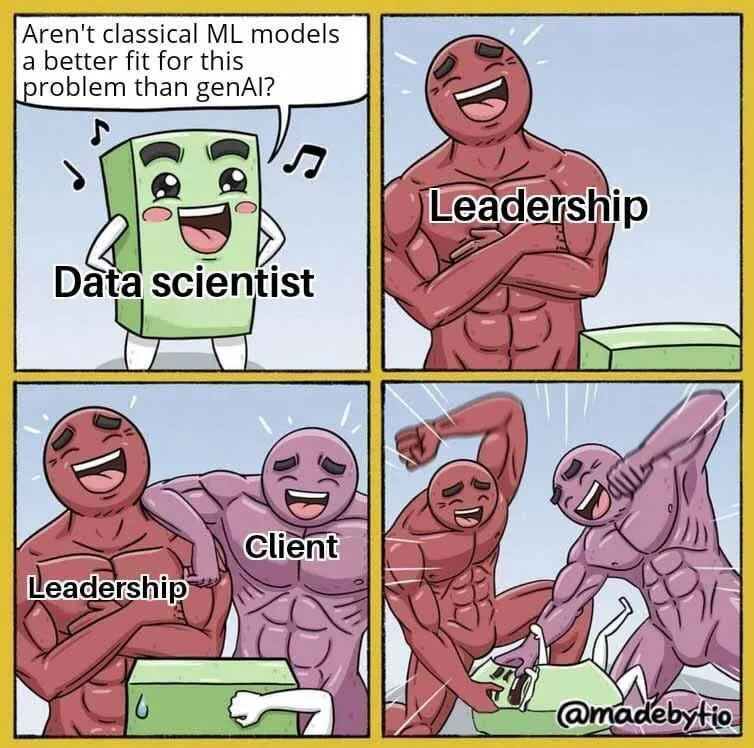
The promises of what the new LLMs can do have been many, and the idea of creating a tool that fits all problems seems more appealing than ever before. And while they have been paramount in the Machine Learning (ML) & AI landscape for the past few years, there are still many problems that LLMs can't solve.
Here, many of the more traditional ML and AI methods still come in handy. ML and AI are much more than LLMs, although the terms are used interchangeably.
Traditional ML and AI methods
Several examples of usecases exist where the more traditional ML models are still the most ideal tool to use.
Tree-based models, such as Gradient Boosted Decision Trees, generally perform better on problems with tabular data, i.e. data that can be arranged as numbers in rows and columns, than transformer based models are (the model architecture behind LLMs).
In some cases, a model needs to be 100% transparent so that the prediction that comes can be explained to the user. Examples could be why a particular person or company gets a bad credit rating, or in diagnoses and recommendations in the healthcare industry, where the explanation of this plays a key role.
This is where so-called Glass Box models such as Logistic Regression or Explainable Boosting Machine come into use, since the output from the model can be explained 100%, unlike Deep Learning (DL) models, including LLMs.
LLMs and Generative AI
When most people talk about generative AI today, they actually mean LLMs. But generative AI is a term that covers more than LLMs. Ten years ago, it was, for example. Generative Adversarial Networks (GANs), which were the hottest in generative AI. They were (and are) used to generate synthetic datasets, an area which is still in rapid development!
However, there are a wide range of challenges where LLMs are the best solution. For example, these could be text-based tasks such as chatbots, sentiment analysis, translation or summarization. The models are also far better at generalizing, where traditional ML models are often trained to solve a very specific problem.
A pursuit of method agnosticism
Although LLMs dominate the public's AI landscape, there are still a number of issues that traditional Machine Learning (ML) models are better geared to address. We're going to make use of both in proprty.ai. The main thing is that the right tools should be used to solve the problems.
At the time of writing, we are primarily dealing with regression. Our models predict residual life of building parts, as well as ongoing maintenance costs.
So while we have projects on the drawing board that take advantage of all the benefits that LLMs come with, we're mostly working with more classic ML methods right now.
We strive to create a product that makes life easier for the user. Whether that happens via programming, or with Machine Learning and LLMs, in principle does not matter as long as the product creates value.


Subscribe to our newsletter
Get insights into new features, customer cases, and news from proprty.ai, delivered straight to your inbox.