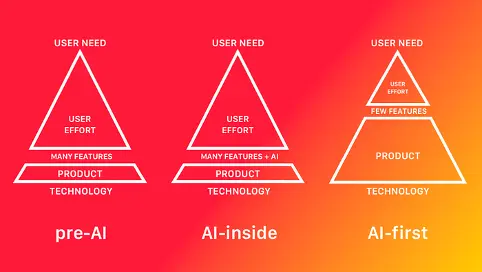
One of the biggest challenges is the technology gap between what single algorithms can accomplish today — like deep learning with image recognition — and what it takes to integrate AI into the heart of complex systems that solve advanced reliability problems. There is a lack of an established methodology to build AI-first products, making it a difficult task to navigate the unexplored territory.
Traditional agile methods that have been the backbone of software development are not necessarily suited to AI-first product development. In a traditional software product, one can simply implement the most critical features to create a “Minimally Viable Product” (MVP). But when it comes to AI-first products, where the user experience should be simple and “just work,” the agile approach falls short.
AI-first products don't require a sea of superficial features, but rather a few of deep, AI-centric features. While this may make the products appear simpler and “smaller” to the user, there is a huge amount of complexity lurking beneath the surface. An AI-first MVP, like a self-driving car, which freezes in 1% of situations, cannot be accepted. Safety and reliability are paramount and cannot be compromised for rapid market congestion.
For us in proprty.ai must navigate a landscape in which the known methods of software development need to be adapted or perhaps even reinvented. We are in the midst of having to balance innovation with reliability, which requires a new approach to product development. It's a journey full of learning, customization and pioneering work to build our service that not only solves time-consuming critical operational functions, but does so with an intuitive understanding and interaction that makes life easier for users.
source: Medium, Building AI-first products


Subscribe to our newsletter
Get insights into new features, customer cases, and news from proprty.ai, delivered straight to your inbox.